

Note
Go to the end to download the full example code.
Time series forecasting#
This tutorial shows how to do zero-shot univariate forecasting with
tabicl.TabICLForecaster.
Make sure the forecast dependencies are installed:
pip install tabicl[forecast]
Time series forecasting as tabular regression#
tabicl.TabICLForecaster is inspired by
TabPFN-TS.
The forecaster wraps tabicl.TabICLRegressor and turns forecasting
into a tabular regression problem:
each row is one timestamp,
the target column is the series value,
time-aware features are added automatically (index, calendar, seasonality).
Note
Compared with tabicl.TabICLClassifier and
tabicl.TabICLRegressor, the forecasting interface is newer and has
not yet been evaluated on a large public benchmark. We may later provide
evaluations and enhancements for time series forecasting.
import numpy as np
import pandas as pd
from tabicl import TabICLForecaster
from tabicl.forecast import plot_forecast
Build a synthetic univariate series#
We create a daily series that mixes a linear trend, a weekly seasonality, an annual seasonality, and Gaussian noise.
This makes the task intuitive: the model should extrapolate trend and recurring patterns into the future.
rng = np.random.default_rng(0)
n_timesteps = 365 * 2  # two years of daily observations
dates = pd.date_range(start="2022-01-01", periods=n_timesteps, freq="D")
t = np.arange(n_timesteps)

trend = 0.05 * t
weekly_season = 5.0 * np.sin(2 * np.pi * t / 7)
annual_season = 10.0 * np.sin(2 * np.pi * t / 365)
noise = rng.normal(scale=1.5, size=n_timesteps)

target = trend + weekly_season + annual_season + noise

# For a single time series, ``timestamp`` and ``target`` are sufficient.
df = pd.DataFrame({"timestamp": dates, "target": target})
df.head()
This DataFrame follows the input format required by
tabicl.TabICLForecaster.predict_df():
required columns:
timestamp,targetoptional column:
item_id(for multiple series)use
prediction_lengthfor regular horizons, orfuture_dfwhen you already know future timestamps/covariates
Define forecast horizon and hold-out period#
We keep the last prediction_length points as a pseudo-future set.
context_dfis the observed history provided to the forecaster.test_dfis only used for visual comparison.
prediction_length = 30
context_df = df.iloc[:-prediction_length]
test_df = df.iloc[-prediction_length:]
Forecast with TabICLForecaster#
tabicl.TabICLForecaster.predict_df() returns one row per future
timestamp, with a point forecast and quantile columns for uncertainty.
forecaster = TabICLForecaster()
pred_df = forecaster.predict_df(context_df, prediction_length=prediction_length)
Predicting time series:   0%|          | 0/1 [00:00<?, ?it/s]
Predicting time series: 100%|██████████| 1/1 [00:05<00:00,  5.89s/it]
Predicting time series: 100%|██████████| 1/1 [00:05<00:00,  5.89s/it]
Plot context, forecast, and held-out truth#
fig, axes = plot_forecast(context_df=context_df, pred_df=pred_df, test_df=test_df)
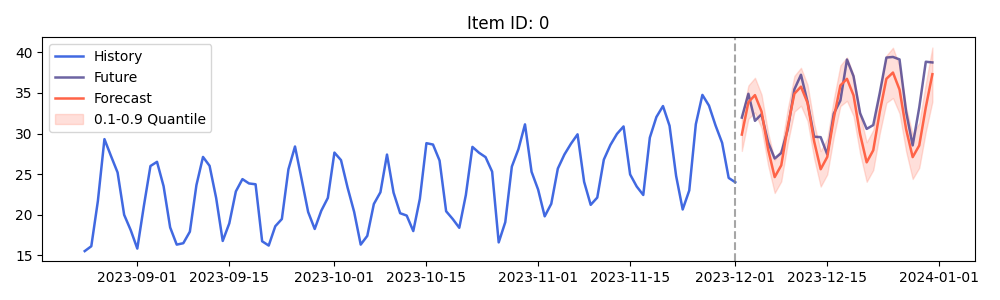
A good forecast should continue the upward trend and recover the recurring
seasonal pattern visible in the held-out future values, which the
TabICLForecaster does successfully in this example.
Total running time of the script: (0 minutes 6.678 seconds)